Project overview
Purpose
The QR Trust PoC is a reference implementation for navigation QR decisions. It asks whether a scanner has enough current evidence to justify opening a destination, warning the user, holding for more evidence, or blocking the action.
The project exists because four facts can all be true at once:
- a QR artifact decodes correctly;
- its payload is signed correctly;
- the issuer was once legitimate; and
- the destination is unsafe or no longer issuer-approved at scan time.
The implementation therefore treats decoding, signature verification, issuer state, destination binding, and runtime safety as separate evidence families.
Note
“Green” is not a claim that a destination is universally safe. It means the configured verifier profile has the required positive evidence and no blocking residual for that decision.
System and decision relationship
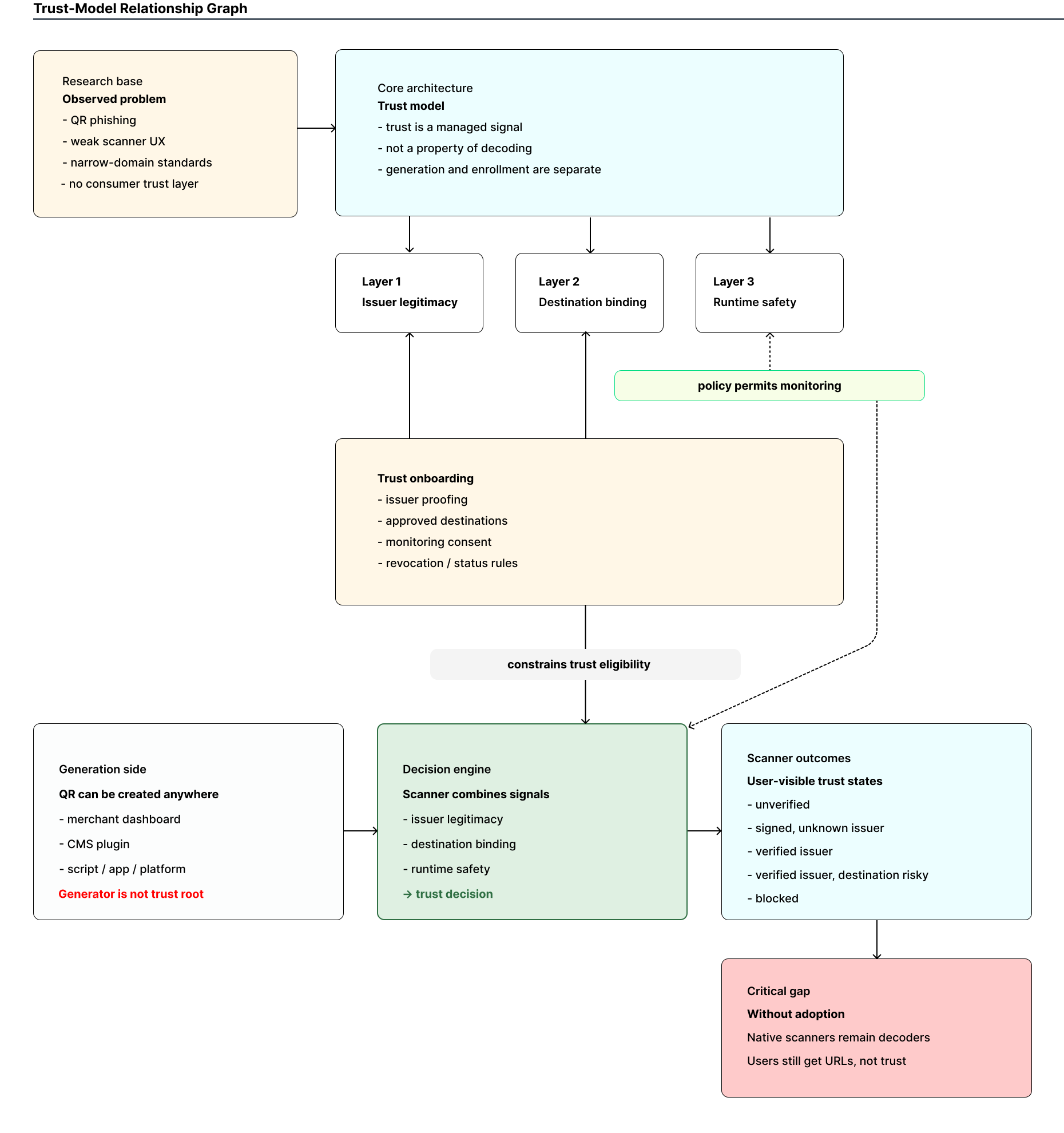
Figure: the trust model separates issuer legitimacy, destination binding, and runtime safety before the decision engine emits a scanner-visible state. Open the annotated graph for its reading order and source documents.
At scan time, the verifier applies that model in a fail-closed sequence:
- require an unambiguous, decodable artifact;
- verify the canonical payload signature;
- evaluate current issuer and destination-policy state;
- require the runtime evidence mandated by the active profile; and
- emit green, orange, or red from the remaining trust residuals.
The shared decision core is implemented in
backend/app/services/trust_residuals_decision.py.
The controlled evaluation and expected residual vectors are documented in the
evaluation guide.
Main implementation surfaces
| Surface | Primary user | Responsibility | Default access |
|---|---|---|---|
| React workbench | Researcher, developer, operator | Guided explanation, scenario generation, camera/upload experiments, and operator state | http://127.0.0.1:5173/ |
| FastAPI verifier | Scanner and workbench clients | Decode, validate, re-evaluate policy state, evaluate the residual vector, and return scanner decisions | http://127.0.0.1:8000/ |
| SwiftUI scanner | iPhone test user | Real-device QR capture and end-user decision presentation | Xcode project |
| Reference network package | Protocol and infrastructure engineer | Publish governance artifacts, propagate events, materialize verifier caches, and record runtime observations | Optional local profiles |
| Deterministic evaluation | Researcher and reviewer | Compare the shared decision core and weaker baselines against controlled expected outcomes | Offline command |
Services and local resource estimates
Default services
| Service | Technology | Default port | Used for | Required in the basic Compose path? |
|---|---|---|---|---|
frontend |
React 19 and Vite | 5173 | Browser workbench and scanner-facing interaction | Yes |
api |
FastAPI and Uvicorn | 8000, or 8443 with local TLS | Verifier endpoints, management surface, artifact analysis, and status | Yes |
postgres |
PostgreSQL 17 | 5432 | Durable issuer/policy state, audit data, outbox state, and management records | Yes |
redis |
Redis 7 | 6379 | Verdict cache, envelope scan budgets, request rate limiting, and short-lived hot-path state | Yes |
nats |
NATS JetStream | 4222; monitor 8222 | Optional propagation of governance and runtime events | No |
| Network workers | Node.js and Effect TypeScript | No public port | Optional outbox publication, subscriptions, artifact publication, and cache materialization | No |
| Secondary verifier | FastAPI | 8001 by default | Optional federation and stale-cache experiments | No |
| Documentation server | MkDocs build plus Python static server | 8088 | Local browsable technical documentation | No |
Hardware planning estimates
These figures are engineering estimates for local work. They have not been measured as capacity limits and should not be used for production sizing.
| Workload | CPU | Memory | Free disk | Expected use |
|---|---|---|---|---|
| Documentation and deterministic evaluation | 2 cores | 4 GB | 5 GB | Reading, MkDocs build, and the offline corpus checker |
| Default Compose profile | 4 cores | 8 GB | 15 GB | API, frontend, Postgres, and Redis |
| Full reference-network and browser workflow | 6–8 cores | 16 GB | 25 GB | Adds NATS, workers, Chromium, and build caches |
| iOS simulator plus full stack | Apple silicon recommended | 16 GB | 35 GB | Adds Xcode and simulator runtimes |
No GPU is required. Persistent production deployment sizing is deliberately out of scope; it requires workload, retention, latency, availability, and runtime- provider measurements that this PoC does not supply.
Storage and message-flow boundaries
- Postgres is authoritative. Durable governance, issuer, destination, audit, and outbox state belongs in Postgres.
- Redis is transient. It backs the verdict cache, envelope scan budgets and request rate limits, but is not the source of truth for issuer trust.
- NATS distributes changes. It carries events to subscribers and cache workers; it does not decide trust.
- Verifier caches are explicit evidence. Cache freshness and accepted-root policy affect scanner decisions rather than being hidden implementation details.
- Runtime observations are scoped inputs. Provider state can clear, warn, block, become stale, or become unavailable; no provider is treated as an infallible oracle.
See the network architecture plan and network-contract index for the detailed model.
Supported workflows
Fast controlled evaluation
Use this when reviewing decision semantics without running containers. It checks 37 controlled cases and the exported report.
Interactive browser demonstration
Use this to generate scenarios, display QR artifacts, scan/upload them, and inspect verifier outcomes in the React workbench.
Native scanner evidence
Use this before physical-device capture. The native app is an end-user scanner test surface, not an administrator console.
Reference-network experiments
Start with the network package README and network contracts. Optional profiles exercise publication, NATS propagation, verifier caches, runtime observations, and second-verifier behavior.
Evidence and claim boundaries
| Evidence | Supports | Does not support |
|---|---|---|
| Unit and integration tests | Implemented behavior under tested inputs | Universal correctness or production resilience |
| 37-case residual corpus | Conformance to specified expected outcomes | Field detection accuracy or prevalence estimates |
| Browser screenshots | Rendered states in the recorded browser flows | Cross-browser universality or user comprehension |
| iPhone artifacts | Deterministic ios-reference reviewer exports of the native decision surfaces and accessibility output, plus one live-scan export for the accepted fixture | Raw screen recordings, App Store readiness, or population-level usability |
| Network smoke drills | Contract and local propagation behavior | Multi-operator governance legitimacy or internet-scale capacity |
For the underlying conceptual argument, read and cite the published SSRN paper. For implementation, continue with the run guide.